
WIFA ROBOTICS / ACADEMY
Build your understanding.
Then build the robot.
Start with a real engineering problem. Work through the equation, try a practical procedure and learn how to check your result.
Collaborative robots
Plan a cell, size its tools, teach accurate paths and validate the complete application.
Explore 25 practical guides ↗PATH 02Image processing with robots
Turn pixels into reliable measurements, then connect perception to robot decisions.
Explore 25 practical guides ↗PATH 03SCARA robots
Understand two-link geometry, build motion profiles and commission a small pick-and-place system.
Explore 25 practical guides ↗PATH 04Design a robot
Work from measurable requirements through mechanics, electronics, control and validation.
Explore 25 practical guides ↗Start with Design a robot if you are building from scratch. Choose SCARA for hands-on kinematics, Robot vision for camera-guided work, or Collaborative robots for application planning. Examples are educational, not certified designs or claimed hardware test results. Read the learning and safety notes ↗
Find your next practical guide
100 guides · 4 paths100 practical guides
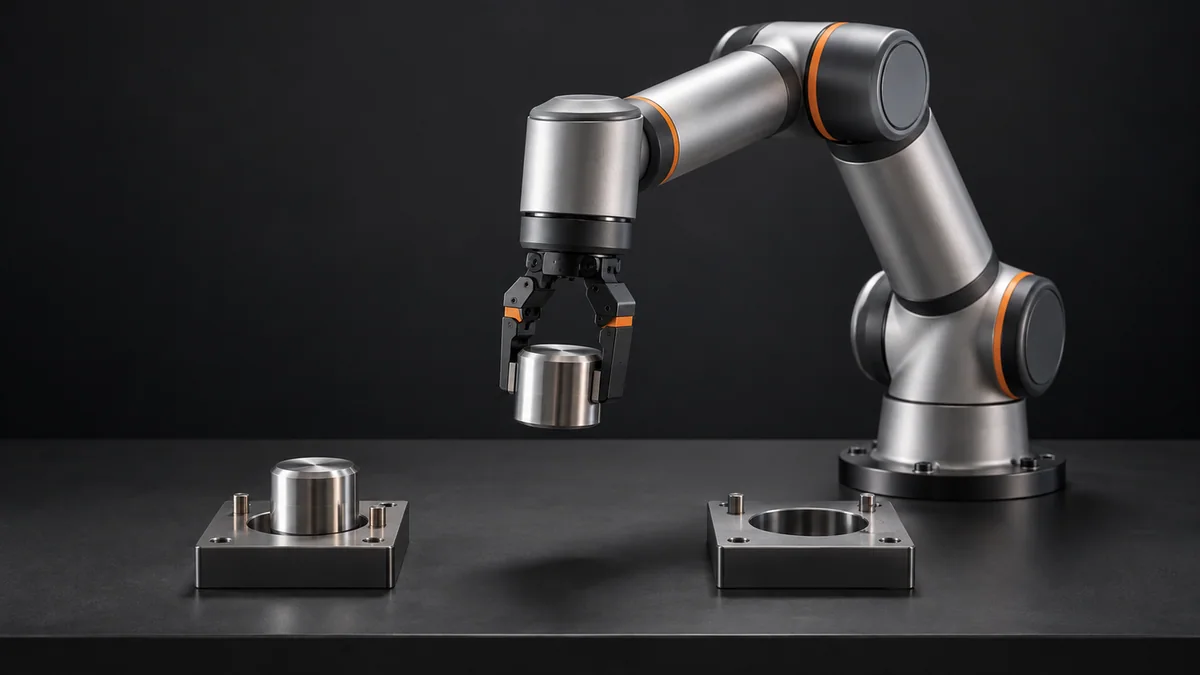
Choose a first cobot task with a cycle-time worksheet
Start with a repeatable transfer between two fixed locations, not a complete factory process. Break the task into movements, gripping, inspection and…
Read the practical guide ↗
Calculate cobot payload including the gripper and adapters
A robot lifts the complete assembly on its flange, not just the saleable part. A payload worksheet prevents a common selection mistake: spending nearly…
Read the practical guide ↗
Find the center of gravity of a cobot tool
The same mass becomes harder to accelerate when it sits farther from the wrist. Locate the combined center of gravity before configuring a tool. Start…
Read the practical guide ↗
Check cobot reach before placing the robot base
A target inside the nominal reach sphere may still be impossible with the required tool orientation. Use a quick distance calculation to reject obviously…
Read the practical guide ↗
Estimate wrist bending moment from an offset payload
A long gripper adapter can be more problematic than a heavier compact tool. Estimate the static moment to compare candidate designs, then use the robot’s…
Read the practical guide ↗
Size a two-finger gripper for a vertical lift
A part held by friction needs enough normal force to resist weight and acceleration. This simple model is useful for a two-jaw parallel gripper with equal…
Read the practical guide ↗
Estimate vacuum cup holding force for pick-and-place
Vacuum holding force starts with pressure difference and effective sealed area. A large cup is not enough if the surface leaks or the vacuum collapses…
Read the practical guide ↗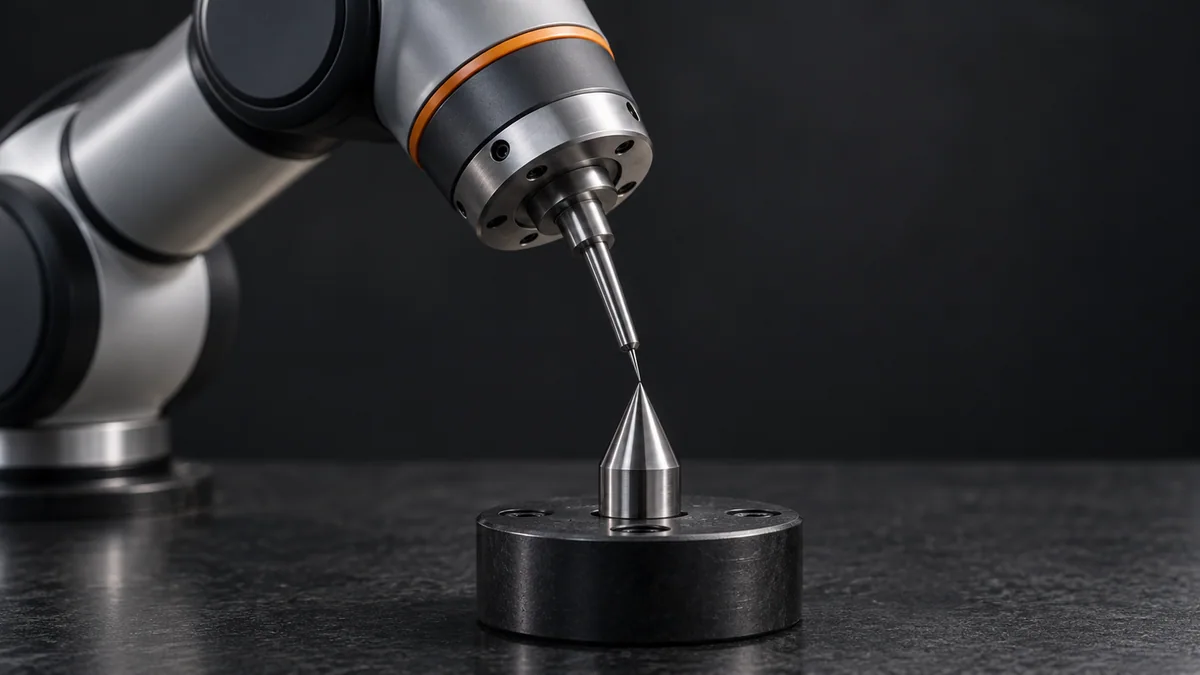
Understand tool-center-point offset errors
A TCP is the point the robot is asked to position. If its offset from the flange is wrong, changing wrist orientation moves the real tool tip away from…
Read the practical guide ↗
Teach a fixture frame instead of reteaching every point
A work frame describes the fixture relative to the robot. Keeping part positions in that frame means a measured fixture relocation can update many points…
Read the practical guide ↗
Measure repeatability without confusing it with accuracy
A robot can return to the same wrong location very consistently. Repeatability describes scatter; accuracy describes closeness to the intended location. A…
Read the practical guide ↗
Build an error budget for a cobot insertion task
An insertion can fail even when every component seems accurate. Robot positioning, fixture location, vision and tool deflection all contribute. Combine…
Read the practical guide ↗
Find the bottleneck in a cobot pick-and-place cycle
Making every movement faster is rarely the best first optimization. Instrument the sequence and find the operation that controls completion. For…
Read the practical guide ↗
Predict why short robot moves never reach top speed
For short distances, acceleration and deceleration consume the entire move. Raising the speed limit then has no effect. A triangular velocity model makes…
Read the practical guide ↗
Use corner blending without cutting into a fixture
Blending avoids a full stop at intermediate waypoints, but the tool no longer passes exactly through the corner. Use a geometric model to understand the…
Read the practical guide ↗
Generate a rectangular tray pattern from one taught origin
A regular tray should not require a separate manually entered coordinate for every pocket. Use row and column offsets in a fixture frame, with explicit…
Read the practical guide ↗
Set up a force-limited insertion experiment in simulation
Position control alone can jam a slightly misaligned part. A simulated compliant insertion helps you understand how stiffness and position error create…
Read the practical guide ↗
Estimate compliance from a bench force-displacement test
Tool deflection can look like a calibration error because the robot reaches the command while the tip bends away. Measure effective stiffness on a…
Read the practical guide ↗
Understand response delay in a robot stopping model
A robot continues moving between an event and the beginning of deceleration. A simple delay-plus-braking model explains why latency matters. It is…
Read the practical guide ↗
Why robot kinetic energy grows with speed squared
Reducing speed can reduce kinetic energy strongly, but energy alone does not tell you whether a contact is acceptable. Use this calculation to understand…
Read the practical guide ↗
Design a robot–PLC handshake with a bounded timeout
A handoff needs agreement about the current job, not just a start pulse. Use an explicit sequence such as idle, request, accepted, running, done and…
Read the practical guide ↗
Debounce a part-present sensor without hiding faults
A bouncing sensor can create several apparent parts from one physical arrival. Require a stable input for a defined interval, then account for the delay…
Read the practical guide ↗
Confirm a gripped part with independent process evidence
A gripper-close command confirms a command, not a successful grasp. Compare jaw position, vacuum or a part sensor with expected ranges. Ambiguous evidence…
Read the practical guide ↗
Add bounded retries to a cobot process
An automatic retry can turn a minor fault into a collision if the part state is unknown. Only retry operations that have a defined recovery pose and an…
Read the practical guide ↗
Measure useful output instead of nominal cobot speed
A fast demonstration can produce little useful output if the cell waits for material or rejects many parts. Separate availability, running speed and…
Read the practical guide ↗
Plan a cobot pilot acceptance test with honest evidence
A successful short demo is not the same as a reliable process. Define acceptance criteria before the pilot and record failures by type. A zero-failure run…
Read the practical guide ↗
Choose camera resolution from the smallest robot feature
Choose resolution from the feature you must locate, not the largest megapixel number. Estimate how many pixels cover the smallest relevant detail across…
Read the practical guide ↗
Estimate lens focal length for a robot camera
A lens must frame the task at the available mounting distance. A pinhole approximation gives a starting focal length; real lens selection must also…
Read the practical guide ↗
Limit motion blur before training a detector
A fast detector cannot recover detail that exposure has smeared across the image. Estimate blur from object speed and exposure duration, then improve…
Read the practical guide ↗
Measure lighting contrast for a robot inspection
Stable lighting often improves a simple algorithm more than a larger neural network. Compare object and background intensity without saturating either.…
Read the practical guide ↗
Segment a colored part with an HSV mask
A color mask is a useful baseline when parts have a distinctive color and lighting is controlled. Convert the image into a representation that separates…
Read the practical guide ↗
Choose a binary threshold using a saved-image test set
Thresholding separates bright and dark pixels with a decision boundary. It works well for stable silhouettes, but a threshold chosen on one image can fail…
Read the practical guide ↗
Clean a robot vision mask without erasing small features
Morphological opening can remove isolated foreground noise; closing can fill small gaps. The kernel has a physical size once the image is calibrated.…
Read the practical guide ↗
Find a part centroid from image moments
The centroid is a convenient first pick target for a solid, uniformly segmented part. Compute it from the mask or contour and then test whether that point…
Read the practical guide ↗
Estimate an elongated part’s orientation with PCA
A long part has a dominant image direction that can guide a gripper angle. Principal-component analysis finds that direction from foreground pixels. It…
Read the practical guide ↗
Convert pixels to millimeters on a flat workplane
A local scale factor works when the camera view is close to orthographic over a small planar region. It is a useful bench exercise and a quick check of a…
Read the practical guide ↗
Collect useful images for camera calibration
Calibration estimates how a camera maps geometry into pixels. Good image coverage matters more than collecting many nearly identical frames. Use a flat,…
Read the practical guide ↗
Check radial distortion before using image-edge targets
A straight physical edge can appear curved through a lens. Calibration-based correction should reduce this systematic distortion, especially near the…
Read the practical guide ↗
Map image points to a robot table with a homography
A homography maps one plane to another image or coordinate plane. It is useful for a fixed camera looking at a flat picking surface. It does not recover…
Read the practical guide ↗
Compose camera and robot coordinate transforms correctly
A detected 3D point is usually expressed in the camera frame, while a robot command needs another frame. Write transform direction explicitly. Most…
Read the practical guide ↗
Plan an eye-in-hand calibration dataset
A wrist-mounted camera changes pose with the robot. Hand–eye calibration relates the camera to the tool or gripper frame. Diverse rotations and accurately…
Read the practical guide ↗
Estimate object pose with a printed fiducial marker
A fiducial marker gives identifiable image corners with known geometry. With calibrated camera intrinsics and the correct physical marker size, pose…
Read the practical guide ↗
Estimate depth from stereo disparity
Stereo cameras infer distance by comparing corresponding image locations. Depth becomes more sensitive to disparity error as objects move farther away.…
Read the practical guide ↗
Prepare a robot vision dataset without leakage
A model can appear excellent when nearly identical frames occur in both training and evaluation. Split by capture session, part instance or production…
Read the practical guide ↗
Evaluate a robot detector with precision and recall
A robot may suffer differently from a false target and a missed target. Report both precision and recall so the decision threshold reflects those…
Read the practical guide ↗
Measure bounding-box overlap with intersection over union
Intersection over union compares a predicted bounding box with a reference. It is useful for defining detection matches, but it does not directly measure…
Read the practical guide ↗
Budget end-to-end latency for vision-guided picking
Inference time is only one part of the delay between a real event and a robot response. Include exposure, transfer, preprocessing, inference, decision and…
Read the practical guide ↗
Compensate conveyor motion using capture timestamps
A coordinate measured from an old image describes where a part was, not where it is now. Constant-velocity prediction is a useful baseline when conveyor…
Read the practical guide ↗
Filter a noisy vision target without ignoring lag
Smoothing reduces visible jitter but delays a moving signal. Use an exponential moving average as a simple baseline and evaluate both noise reduction and…
Read the practical guide ↗
Propagate pixel uncertainty into robot position error
Camera localization uncertainty should be expressed in the units used by the robot. A simple local scale converts pixel scatter into millimeters; a…
Read the practical guide ↗
Build a vision-guided picking acceptance checklist
A perception pipeline is useful only when it creates valid, timely and executable robot targets. Test the complete chain with labeled scenarios, including…
Read the practical guide ↗
Understand the four axes of a SCARA robot
A common SCARA combines two horizontal rotary joints, a vertical axis and a tool-rotation axis. This arrangement suits planar transfer and insertion…
Read the practical guide ↗
Choose SCARA link lengths from the required workspace
Two link lengths define an ideal annular planar workspace. Start with the required inner and outer radii, then leave room for joint limits, fixtures and…
Read the practical guide ↗
Calculate SCARA forward kinematics by hand
Forward kinematics converts measured joint angles into the tool’s planar position. Derive this small model before debugging a controller: it gives an…
Read the practical guide ↗
Solve two-link SCARA inverse kinematics
Inverse kinematics finds joint angles for a requested x-y target. A planar two-link arm often has two solutions. The calculation must reject unreachable…
Read the practical guide ↗
Keep a continuous SCARA elbow branch along a path
Choosing an inverse-kinematics solution independently at every point can make the elbow flip. Track the previous joint state and select a nearby valid…
Read the practical guide ↗
Build the planar SCARA Jacobian
The Jacobian connects small joint movements to small tool movements. It explains velocity limits, force transmission and singularities. Differentiate the…
Read the practical guide ↗
Recognize SCARA singularities before commanding motion
At full extension or a folded alignment, the two-link arm loses an independent instantaneous motion direction. Inverse kinematics may still return a…
Read the practical guide ↗
Convert a desired SCARA tool velocity into joint speeds
A modest Cartesian speed can require very different joint speeds at different poses. Solve the local Jacobian equation, then check the result against each…
Read the practical guide ↗
Estimate SCARA joint torque from a planar tool force
A tool force becomes joint torque through the robot geometry. The Jacobian transpose gives a useful static relationship. It excludes acceleration,…
Read the practical guide ↗
Apply joint limits to a SCARA workspace map
An ideal workspace annulus includes points that may be excluded by real joint stops. Sample the permitted joint ranges and map them through forward…
Read the practical guide ↗
Convert stepper pulses into SCARA joint angle
A stepper drive receives pulses, while the kinematic model uses angles. Keep the conversion explicit, including microstep setting and gear reduction.…
Read the practical guide ↗
Why microstepping is not the same as positioning accuracy
Microstepping increases commanded angular resolution and can improve smoothness. The actual shaft position also depends on load, torque ripple, friction…
Read the practical guide ↗
Select a belt reduction for a SCARA joint
A belt reduction trades output speed for torque and nominal angular resolution. It also changes reflected inertia and mechanical behavior. Start with…
Read the practical guide ↗
Estimate how belt compliance affects SCARA endpoint error
A compliant transmission twists under load, causing position error even when the motor encoder reaches its target. A rotational stiffness model helps…
Read the practical guide ↗
Measure SCARA homing repeatability
Homing establishes a reference after startup, but switch activation can vary with speed, mechanics and signal filtering. Measure the final reference…
Read the practical guide ↗
Measure backlash by approaching a SCARA target from both sides
Lost motion after reversing direction can make a robot accurate from one approach and wrong from another. Compare opposing approaches at the same target…
Read the practical guide ↗
Convert lead-screw rotation into SCARA vertical travel
The vertical axis converts motor rotation into linear movement. Use screw lead, not thread pitch, when multiple starts are present. An incorrect…
Read the practical guide ↗
Estimate SCARA vertical-axis lifting torque
A screw-driven lift requires torque to raise its load and accelerate it. Include the complete moving assembly, then account for screw efficiency and…
Read the practical guide ↗
Keep SCARA tool yaw constant while the arm moves
If the tool must keep a label or connector aligned, the wrist has to compensate for shoulder and elbow rotation. Compute orientation from the complete…
Read the practical guide ↗
Design a trapezoidal velocity profile for a SCARA axis
A trapezoidal profile accelerates, cruises and decelerates. It is easy to calculate and useful as a baseline, although a real controller may smooth…
Read the practical guide ↗
Use cubic time scaling for a smooth SCARA demonstration
A cubic time law makes joint velocity start and end at zero. It is useful for simulation and low-level understanding of trajectory generation. It does not…
Read the practical guide ↗
Make a SCARA tool follow a straight Cartesian line
Interpolating joint angles does not generally make the tool move in a straight line. Define the line in Cartesian coordinates, solve inverse kinematics…
Read the practical guide ↗
Generate a SCARA circular path with chord-error control
A circle approximated by line segments deviates between sample points. Choose sampling from permitted geometric error, then check kinematics and timing.…
Read the practical guide ↗
Calibrate SCARA link lengths using independent reference points
Nominal CAD dimensions may differ from effective joint-to-joint lengths. Calibration should use multiple configurations so link-length errors can be…
Read the practical guide ↗
Commission a SCARA pen-plotter prototype in stages
A pen plotter is a useful low-force demonstration of geometry, but the moving arm still presents hazards. Separate offline kinematic verification,…
Read the practical guide ↗
Write measurable requirements before designing a robot
A useful robot specification describes a task in measurable terms: what moves, how far, how accurately and under which conditions. Begin with the required…
Read the practical guide ↗
Choose robot degrees of freedom from the task
Every added axis increases mechanical, sensing and control work. Identify the independent position and orientation variables the task truly needs. A…
Read the practical guide ↗
Estimate gravity torque for a robot shoulder joint
For a vertical-plane arm, the shoulder must support both the payload and the arm itself. Use perpendicular lever arms in the demanding pose, then add…
Read the practical guide ↗
Calculate link inertia before choosing acceleration
Mass location matters as much as total mass when a joint accelerates. A long light link can require substantial torque, and a small payload at the tip can…
Read the practical guide ↗
Check motor heating with RMS torque over a duty cycle
A motor may tolerate a brief high torque but overheat during sustained operation. An RMS torque calculation is a useful thermal screening tool when torque…
Read the practical guide ↗
Use gear reduction to understand reflected load inertia
A reduction changes the inertia seen by the motor as well as torque and speed. A simple reflected-inertia calculation helps explain actuator behavior, but…
Read the practical guide ↗
Estimate robot-link bending before adding a larger motor
If a link bends, a stronger actuator may increase force without improving tool accuracy. A cantilever approximation gives an early estimate of stiffness…
Read the practical guide ↗
Screen a solid robot shaft for torsional stress
A shaft must transmit torque without excessive stress or twist. A simple circular-shaft formula is useful for comparing diameters, but shoulders, keyways…
Read the practical guide ↗
Estimate wheel torque for a small mobile robot
A wheeled prototype needs enough traction and motor torque to accelerate its mass against resistance. Begin with a level-floor force budget, then extend…
Read the practical guide ↗
Choose encoder resolution from joint-position sensitivity
Encoder resolution defines the smallest reported angle increment, not the complete positioning accuracy. Convert counts into angular and endpoint…
Read the practical guide ↗
Create a low-voltage robot power budget
A power budget separates steady loads from startup and acceleration peaks. Add controllers, sensors, fans and conversion losses instead of sizing the…
Read the practical guide ↗
Calculate voltage drop in a robot power cable
A long or thin supply path can cause resets when motors draw current. Estimate the complete round-trip resistance, then measure voltage at the load during…
Read the practical guide ↗
Estimate electronics temperature rise before enclosing a robot controller
A controller that runs cool on an open bench can overheat in an enclosure. A first-order thermal resistance model links power loss to temperature rise. It…
Read the practical guide ↗
Scale a low-voltage analog sensor with a resistor divider
A resistor divider can scale a known low-voltage analog signal into an ADC range. It does not provide isolation, overvoltage protection or compatibility…
Read the practical guide ↗
Convert ADC codes into physical sensor units
Raw ADC numbers become useful only after you define reference voltage, sensor transfer function and calibration. Use a clear ideal conversion for…
Read the practical guide ↗
Estimate joint speed from encoder counts
Speed estimation turns count changes over time into angular velocity. Short windows react quickly but amplify quantization; longer windows smooth the…
Read the practical guide ↗
Choose a control sampling rate with delay in mind
A controller needs a sampling period appropriate to the dynamics it is trying to regulate. Nyquist is a signal-reconstruction boundary, not a complete…
Read the practical guide ↗
Understand proportional control with a bounded actuator
Proportional control commands effort in proportion to error. Increasing gain increases response, but physical actuator limits and plant dynamics prevent…
Read the practical guide ↗
Prevent integral windup in a simulated robot controller
Integral action can remove steady error, but it can keep accumulating when the actuator is saturated. When the target changes, that stored integral may…
Read the practical guide ↗
Design a robot process as explicit states
A collection of independent if statements can accidentally allow incompatible actions. A state machine makes allowed transitions visible and provides a…
Read the practical guide ↗
Frame robot serial messages so corrupted data is rejected
A byte stream has no inherent message boundaries. A robust parser needs a bounded length, clear framing, integrity check and timeout. Test it on stored…
Read the practical guide ↗
Use a watchdog to detect a stalled robot application
A watchdog can detect missing progress, but only if the signal being monitored represents meaningful healthy work. A timer interrupt that keeps toggling…
Read the practical guide ↗
Give a robot simulation physically meaningful mass and inertia
A robot model can look correct while behaving unrealistically because mass or inertia is missing or invalid. Begin with simple link shapes and verify…
Read the practical guide ↗
Budget assembly tolerances before printing robot parts
A prototype can fail because several small dimensional deviations add in the same direction. Trace the dimension chain that controls the fit. Do not…
Read the practical guide ↗
Build a robot verification matrix and release checklist
A robot is not finished when it moves once. Connect each requirement to evidence, configuration and a pass/fail decision. Separate functional…
Read the practical guide ↗No matching guides yet
Try a broader term or choose another learning path.