
ROBOTICS RESEARCH / R021
When robots disagree
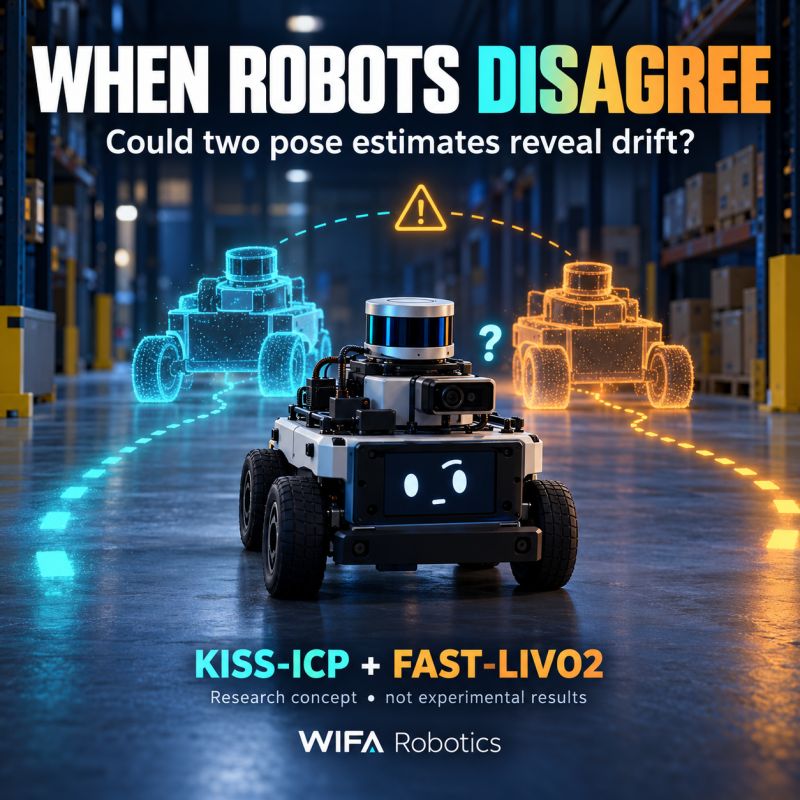
A robot can be confidently wrong. Could a second opinion help?
Reading KISS-ICP and FAST-LIVO2 got me thinking about a simple experiment. KISS-ICP estimates motion from LiDAR point clouds. FAST-LIVO2 combines LiDAR, camera and IMU measurements.
What if we ran both on the same robot and monitored their disagreement? After matching timestamps and coordinate frames, a growing difference in estimated motion might help flag calibration problems or visual degradation.
I would start with recorded data, add controlled camera blur and calibration offsets, then measure how early the warning appears at a fixed false alarm rate. I would also compare it with the fusion system’s own residual checks.
The catch: both use LiDAR. They could agree and still be wrong. This is a research hypothesis to test, with a clear shared failure mode, rather than a demonstrated safety guarantee.
Two estimators arguing might be useful. Someone still has to referee.
Credit to the KISS-ICP and FAST-LIVO2 teams, including Ignacio Vizzo and Chunran Zheng.
KISS-ICP: https://lnkd.in/e-V9fCrD
FAST-LIVO2: https://lnkd.in/eNSsERNN
Would you trust agreement, or learn more from disagreement?
#WIFARoboticsIdeas #Robotics #SLAM #SensorFusion
Credit also to the last authors: Cyrill Stachniss (KISS-ICP) and Fu Zhang (FAST-LIVO2).