
ROBOTICS RESEARCH / R003
When should a robot distrust a sensor?
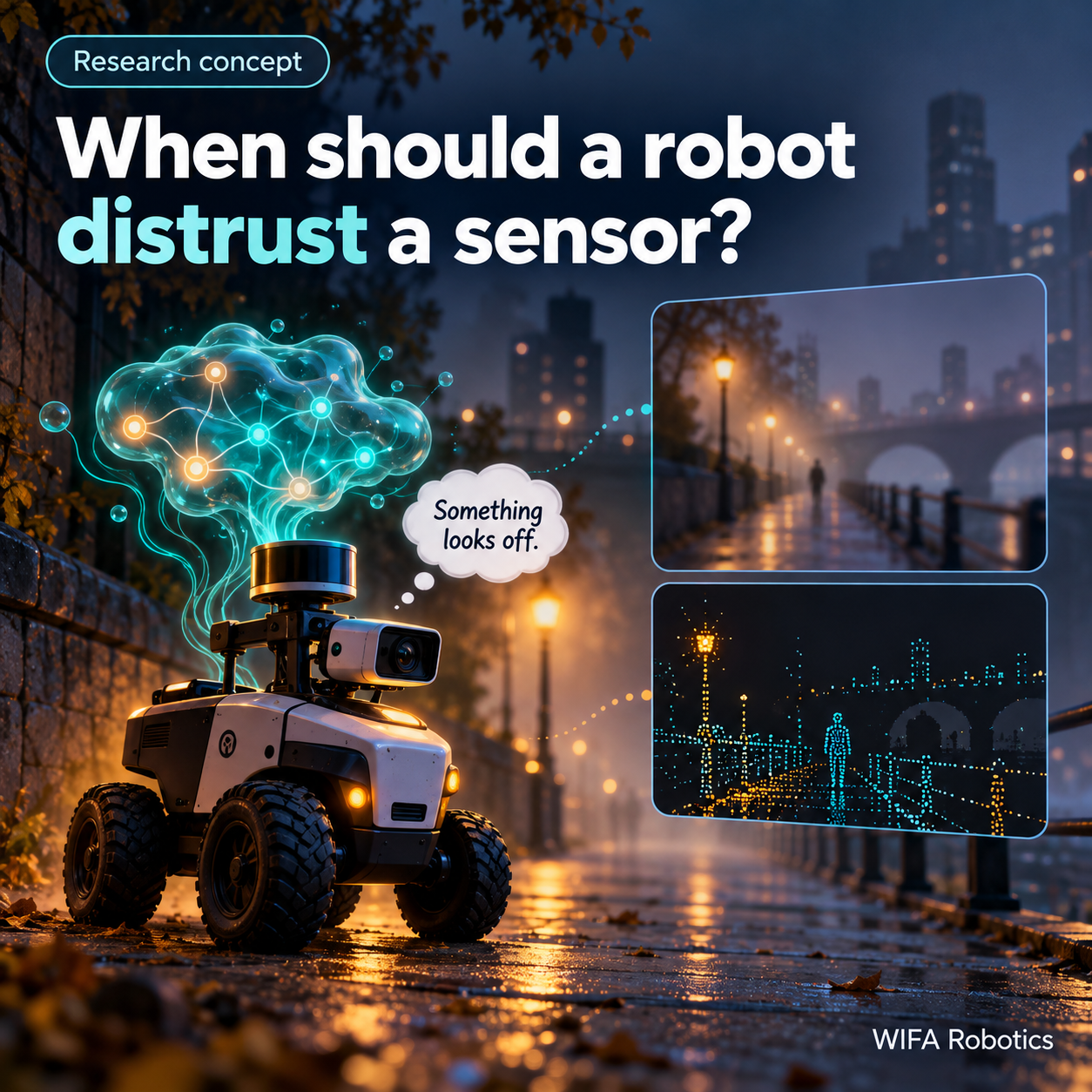
What if a robot could learn when not to trust one of its senses?
WIFA Robotics idea #003: use a compact liquid network to gate FAST-LIVO2 measurements when cameras blur, exposure shifts, or LiDAR returns disappear.
FAST-LIVO2 sequentially fuses IMU, LiDAR, and direct visual measurements in an error-state iterated Kalman filter built around one voxel map. The liquid-network flight paper shows compact continuous-time policies generalizing beyond their training environment. It does not estimate sensor reliability, so connecting them is a proposed experiment.
I would replay synchronized trajectories with controlled camera blur, exposure changes, and LiDAR point dropout. A small LTC or CfC model would read residual and scene-quality signals, then predict short-horizon reliability weights before each measurement update. Compare it with static thresholds, a GRU gate, and an oracle label under matched data and compute. Measure trajectory error, divergence rate, false suppression, and gate latency.
The catch: an unfamiliar but healthy sensor pattern could be mistaken for failure, and suppressing useful measurements may make localization worse. A conservative fallback and clean-condition drift check are essential.
Credit to the FAST-LIVO2 team, including Chunran Zheng and Fu Zhang, and the liquid-network team, including Makram Chahine and Daniela Rus.
FAST-LIVO2: Fast, Direct LiDAR-Inertial-Visual Odometry
https://lnkd.in/eiX452Gw
Robust flight navigation out of distribution with liquid neural networks
https://lnkd.in/ewng6ShK
Which signal would you trust most before down-weighting a sensor update?
#WIFARoboticsIdeas #SensorFusion #SLAM #LiquidNeuralNetworks